Dr. Annika Hagemann
Research engineer for 3D computer vision
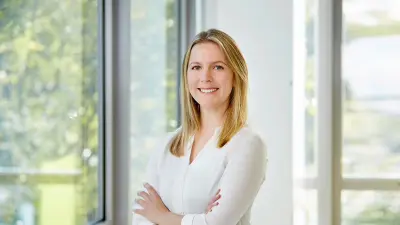
I am a research engineer at the Bosch Computer Vision Lab, focusing on 3D computer vision, deep learning and camera calibration. I originally studied physics with a focus on complex and neural systems before turning to the field of computer vision. Our research aims at finding novel algorithms that enable 3D perception based on cameras — for example, for automated driving and robotics.
Please tell us what fascinates you most about research.
Our research aims at finding novel, better algorithms to enable machines to “see” their environment. What fascinates me about this field is that vision appears to be effortless for humans yet translating this ability into algorithms is an extremely complex task. Although the progress in recent years has been impressive, there are still so many open problems that are exciting to investigate.
What makes research done at Bosch so special?
The connection of research and practical application. Most of our research has a clear practical purpose and it is motivating to know that your results can be applied by others in future. At the same time, we can dive into completely new topics that are not always directly applicable but could provide the basis for future applications.
What research topics are you currently working on at Bosch?
My current research is focused on 3D computer vision. Our goal is to enable precise camera-based 3D perception, which includes, for instance, the measurement of distances to other traffic participants in automated driving. A concrete problem is, for example, the calibration, because 3D environment perception requires an exact mathematical model for the projection of the camera. Therefore, my colleagues and I develop novel algorithms to achieve highly accurate calibration, and to ensure this accuracy during application.
What are the biggest scientific challenges in your field of research?
The capabilities of large AI models for processing and interpreting image data have increased significantly (e.g., ChatGPT and similar systems). However, major challenges remain in 3D scene perception: models must not only produce visually plausible, statistically likely results, but also enable centimeter-accurate, metrically correct measurements. At the same time, our solutions must run in real time on resource-constrained, energy-efficient hardware — a major challenge, as current progress is often achieved by scaling model size.
How do the results of your research become part of solutions “Invented for life”?
An accurate perception of the surroundings is essential not only for automated driving, but also for intelligent robots, with applications spanning many areas of our lives. Our research contributes to the accuracy and safety of these systems.
Curriculum vitae
Since 2023
Research Engineer Deep Learning for Computer Vision and Multi-Sensor Calibration, Bosch Research
2020 to 2023
PhD student, Karlsruhe Institute of Technology and Bosch Research
2018 to 2019
Max Planck Institute for Dynamics and Self-Organization, neural systems theory group
2013 to 2019
Master of Science in Physics at Georg-August University Göttingen
Selected publications

A. Hagemann et al. (2023)
- Hagemann, A., Knorr, M., & Stiller, C.
- International Conference on Computer Vision (ICCV)
A. Hagemann et al. (2021)
- Hagemann, A., Knorr, M., Janssen, H., & Stiller, C.
- International Journal of Computer Vision, 1-16.
A. Hagemann et al. (2021)
- Hagemann, A., Knorr, M., & Stiller, C.
- Accepetd for publication at IEEE/CVF, WACV 2022.
A. Hagemann et al. (2021)
- Hagemann, A., Knorr, M., Janssen, H., & Stiller, C.
- In Pattern Recognition: DAGM GCPR 2020. Springer International Publishing. (Best Paper Award 2020)
Get in touch with me
Dr. Annika Hagemann
Research engineer for 3D computer vision