Neuro-symbolic AI
What motivates us
While deep learning and neural networks have achieved remarkable success in many domains, they often struggle to incorporate structured domain knowledge and reasoning into their predictions and outputs.
This has led to growing interest in so-called neuro-symbolic AI , which aims at combining elements from both deep learning and automated reasoning, planning, and knowledge representation, in order to achieve the best of both worlds: the flexibility and data-driven performance of deep learning as well as the logical consistency and grounded reasoning of symbolic methods .
Our approach
Neuro-symbolic AI approaches are ideal to exploit the knowledge of domain experts for industrial AI solutions. We develop methods that help leveraging domain experts' knowledge in a way that makes it machine-accessible (e.g., as knowledge graphs ), to gain further knowledge via reasoning and prediction, and exploit knowledge for search, exploration, machine learning and problem solving .
Application
We are particularly focusing on applications that leverage Bosch’s existing strength in industrial knowledge graphs . By integrating graph neural network approaches with industrial knowledge graphs, we can develop analytical tools that can answer queries requiring both observational data and explicit rules provided by Bosch domain experts.
Machine learning on knowledge graphs
Knowledge graphs (KGs) are powerful for search and exploration applications . Reasoning can lead to further knowledge and KG validation and thus improved KG quality. With Bosch having lots of know-how in various domains, knowledge needs to be machine accessible (e.g., as KG) to allow for industrial AI solutions . Therefore, neuro-symbolic AI is ideal to exploit the knowledge of domain experts for AI solutions at Bosch. With our work on neuro-symbolic AI we aim to combine symbolic and subsymbolic methods to incorporate (Bosch) domain knowledge into ML models, verify results of ML models, reduce the amounts of training data, and exploit knowledge for search, exploration, and problem solving.
Use case
Machine learning on knowledge graphs
-
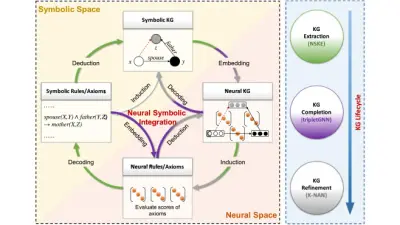
Machine learning with knowledge graphs: integrating structured domain knowledge with neural networks to enable reasoning, prediction, and knowledge completion in industrial AI applications.
Our research
Exploit domain knowledge
We develop methods that allow for integration of rules and structured domain knowledge into machine learning models . These include, for example, ontology-enhanced knowledge graph embedding techniques.


Gaining new insights
Neuro-symbolic AI methods allow to extract new insights from manufacturing data structured in a knowledge graph form. For example, this concerns automatically learning rules and ontologies from the data.
Knowledge graph completion and cleaning
Knowledge graphs (KGs) are often incomplete or of mixed quality. Neuro-symbolic AI methods help to increase the KG quality by detecting inconsistencies or by predicting missing links in KGs.

Advanced AI on top of knowledge graphs
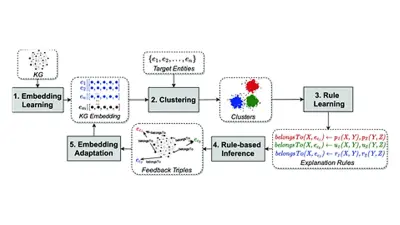
AI methods on top of knowledge graphs allow one to explore and automatically analyze structured knowledge. For example, we develop techniques that simultaneously exploit ontologies and machine learning for answering complex queries over incomplete knowledge graphs, as well as approaches for explainable clustering over symbolic knowledge.
-
Answer Set Programming for industrial problem solving: declarative approach combining logical reasoning with optimization to solve complex scheduling, configuration, and manufacturing challenges.
References
Feng, W., Zhang, J., Dong, Y., Han, Y., Luan, H., Xu, Q., Yang, Q., Kharlamov, E., & Tang, J. (2020). Graph Random Neural Networks for Semi-Supervised Learning on Graphs. NeurIPS. [PDF]
Gad-Elrab, M.H., Stepanova, D., Tran, T-K., Adel, H., & Weikum, G. (2020). ExCut: Explainable Embedding-based Clustering over Knowledge Graphs. ISWC. [PDF]
Jain, N., Tran, T-K., Gad-Elrab, M.H., & Stepanova, D. (2021). Improving Knowledge Graph Embeddings with Ontological Reasoning. ISWC. [PDF]
Shi, Y., Cheng, G., Tran, T-K., Kharlamov, E., & Shen, Y. (2021). Efficient Computation of Semantically Cohesive Subgraphs for Keyword-Based Knowledge Graph Exploration. WWW. [PDF]
Tran, T-K., Stepanova, D., Kharlamov, E., & Stroetgen, J. (2020) Fast Computation of Explanations for Inconsistency in Large-Scale Knowledge Graphs. WWW. [PDF]
Wang, P-W., Stepanova, D., Domokos, C., & Kolter, Z. (2020). Differentiable Learning of Numerical Rules from Knowledge Graphs. ICLR. [PDF]
Shi, Y., Cheng, G., Tran, T.-K., Tang, J., & Kharlamov, E. (2021). Keyword-Based Knowledge Graph Exploration Based on Quadratic Group Steiner Trees. IJCAI. [PDF]
Knowledge-driven problem solving

Answer-Set Programming (ASP) is a prominent approach to declarative problem solving oriented towards difficult search and optimization problems such as resource allocation, configuration or design of assembly lines.
Rich modeling language and the availability of highly optimized solvers make ASP especially attractive for industry allowing to reduce implementation and maintenance costs as well as improve the man-machine interaction of deployed solutions.
Our research
Scalable rule-based AI methods
We develop AI methods that combine answer set programming with classical optimization techniques (e.g., large neighborhood search) to improve scalability of the resulting systems.


Explainable rule-based AI methods
Explanations are very important in the context of manufacturing optimization, but typically existing solutions are black boxes, which are inaccessible to users. We develop explainable methods that allow for understanding the reasons behind computed solutions.
Combining rule-based methods with neural networks
Machine Learning is data-driven and agnostic to vital experts’ knowledge. To address this, we work on novel AI methods that combine rule-based answer set programming systems with (deep) learning thus allowing for advanced reasoning on top of ML predictions.
Cutting-edge research
Our tools and methods in the area of rule-based, knowledge-driven problem solving result from world-class research of our academic collaborators at the Vienna University of Technology and colleagues at BCAI. We constantly challenge and advance the state-of-the-art in the field, publish at top-tier venues, and exploit the developed methods in real-world Bosch applications.
-
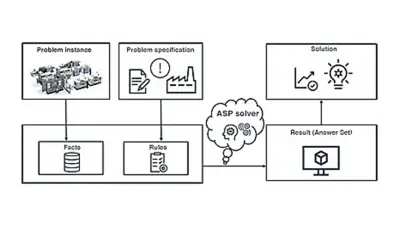
Expert knowledge integration: combining diverse data sources and domain expertise into unified AI systems that leverage both symbolic knowledge and machine learning capabilities.
References
Eiter, T., Higuera, N., Oetsch, J., & Pritz, M. (2022). A Neuro-Symbolic ASP Pipeline for Visual Question Answering. ICLP. [PDF]
Eiter, T., Higuera, N., Oetsch, J., & Pritz, M. (2022). A Confidence-Based Interface for Neuro-Symbolic Visual Question Answering. AAAI. [PDF]
Eiter, T., Geibinger, T., Musliu, N., Oetsch, J., Skocovský, P., & Stepanova, D. (2021). Answer-Set Programming for Lexicographical Makespan Optimisation in Parallel Machine Scheduling. KR 2021: 280-290. [PDF]
Eiter, T., Geibinger, T., Ruiz, N.H., Musliu, N., Oetsch, J., & Stepanova, D. (2022). Large-Neighbourhood Search for Optimisation in Answer-Set Solving. AAAI. [PDF]
Eiter, T., Geibinger, T., Ruiz, N.H., Musliu, N., Oetsch, J., & Stepanova, D. (2022). ALASPO: An Adaptive Large-Neighbourhood ASP Optimiser. KR.
Embodied Neuro-symbolic AI for Robotics
Vision-Language-Action (VLA) systems have advanced robot learning considerably. However, they can still struggle to generalize reliably, reason over complex tasks, and provide auditable safety guarantees. These limitations restrict their use in real-world and safety-critical environments. Embodied Neuro-Symbolic AI (Embodied NeSy) addresses these challenges by combining learned perception, planning, and control with machine-readable knowledge and symbolic constraints. By combining knowledge-guided perception, constraint-aware symbolic planning, and hybrid learning, Embodied NeSy enables robots to understand their environment and learn abstractions for new tasks. It also helps them demonstrate compliance with safety and operational requirements, supporting scalable and trustworthy deployment.
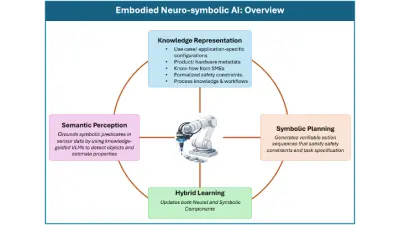
Research on Embodied Neuro-symbolic AI
Our recent work includes ReSync, which enables robots to recover from failures and extract abstract knowledge that can help prevent similar failures in future tasks. It turns local recovery strategies into reusable, failure-aware planning knowledge.
GaP (Graph-as-Policy) provides a multi-agent framework for variational automation. It generates and refines computation graphs from a modular skill library to support robust performance in open-world tasks.
Our ongoing research focuses on generalizable dexterous manipulation, interactive multi-agent systems for open-world robot manipulation, and memory-augmented reasoning for long-horizon tasks. Together, these efforts highlight key strengths of Neuro-symbolic AI: interpretable reasoning, continual learning, and auditable deployment across diverse domains. The goal is to build robots that can adapt to changing environments while remaining reliable and verifiable.
Neuro-symbolic AI in Manufacturing
Manufacturing requires a clear understanding of cause-and-effect relationships to ensure consistent quality and efficient operations. Causal graph learning models how process variables influence one another. Such detailed models are indispensable for root cause analysis, the systematic method of pinpointing the fundamental reason behind observed problems or anomalies. A highly effective approach hinges on deeply integrating domain knowledge directly from expert operators, including different types of process metrics and active control actions. They also account for the temporal order and dependencies between process variables. To ensure the model's validity and practical relevance, constraints are applied to logically govern how these factors can be linked, reflecting real-world physical limitations and operational rules. The resulting model helps manufacturers trace how faults emerge and develop throughout a process. We implement this approach through a multi-agent copilot that supports teams in manufacturing environments. This system is engineered to integrate and process a diverse array of data inputs, including production line data, process observations, machine telemetry, and configuration settings. Within this collaborative environment, multiple specialized agents work in concert, each leveraging shared memory and integrated domain knowledge. A common infrastructure supports the agents with causal discovery, data processing, and actionable recommendations. Together, these agents help manufacturers optimize complex processes.
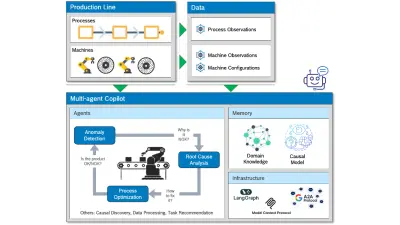
- Anomaly detection: Detects observations that exceed defined normal ranges or tolerance limits. This identifies unusual or potentially problematic process behavior.
- Root cause analysis: This agent identifies the most likely root cause and failure path behind an anomalous process variable. It works to trace back through the causal model to understand why the anomaly occurred and the sequence of events that led to it.
- Process Optimization: This agent focuses on determining how to intervene by finding the optimal value of the control variable(s). Once the system identifies a root cause, the agent suggests adjustments that can correct the issue or improve performance. This collaborative, agent-based structure helps manufacturers address complex challenges in a structured and explainable way.
Use Case: Grinding Planar Sensor Elements
Grinding planar sensor elements presents a demanding manufacturing challenge. This operation is inherently challenging primarily due to the material properties of the elements themselves: they are fabricated from ceramic, a substance known for being both fragile and expensive. In the evaluated use case, the scrap rate is estimated at 2–4%, primarily because of operational errors. Human interventions currently employed by operators, whether highly experienced or novices, have proven largely ineffectual, characterized as “hit-or-miss” with an average success rate of only about 35%. The system supports operators by recommending robot configuration settings and explaining why a proposed intervention should improve the process. The long-term objective is to shift from manual parameter adjustments towards a more closed-loop and self-adjusting grinding process. Initial evaluations indicate a 79.7% improvement in fault-assignment accuracy compared with machine operators. Before publication, clarify whether this figure measures a relative improvement, an absolute percentage-point difference, or another evaluation metric.
References
Embodied Neurosymbolic AI Systems for Robotics: Making Robot Behavior Auditable, Safe, and Scalable, IR: 2026/1168.
Recover, Discover, Plan: Learning Skills and Concepts from Robot Failures, arXiv:2606.18328, 2026, https://arxiv.org/abs/2606.18328
A Graph-as-Policy Multi-Agent Self-Learning Harness for Variational Automation, 2026, https://graph-robots.github.io/graph-as-policy-anonymous
Causal analysis, Multi-agent copilot, Anomaly Detection, Root Cause Analysis, Process Optimization, Use-case: Excerpts from "NeSy-Webpage-2026.docx" sections 10-13.